Nick Seeler: good "defensive defensemen" are real, they're just rare
The stats have liked Seeler for a while; the thing he's famous for went unpriced. Price the blocking and he's a top-20 defensive defenseman — and the league's most extreme blocking specialist turns out to be a perfectly sound even-strength defender, exactly where critics predict drowning.
Nick Seeler has earned the respect of even the most skeptical Flyers fans since his arrival in 2021. His teammates revere him, he is a genuinely interesting locker-room quote, and he has rightfully earned his reputation as a defensive defenseman. What makes him unusual is who he has united: the old-school eye-test diehards and the modern analytics community generally agree he's good. Yes, he fights and hits and can effectively clear the crease. But he has also, by now, consistently put up good underlying numbers.
But there has always been one part of his game that even the friendliest numbers never actually measured: the thing you just watched. The blocking has stayed a reputation, a wince, and a box-score column nobody trusts — no public model prices the act itself. As of part 3 of this series, it is a number in goals.
Pricing it lets this post make a bigger claim, and test it honestly: the good "defensive defenseman" is real, just rare. The skeptic's model of the blocking specialist has always been the opposite — that blocks are a symptom, piled up by players who spend their shifts pinned in their own end, and that a block-heavy profile is what drowning looks like in the box score. Hold that thought; the whole post builds to weighing it against the most extreme blocking specialist in the league.
The block is the blind spot
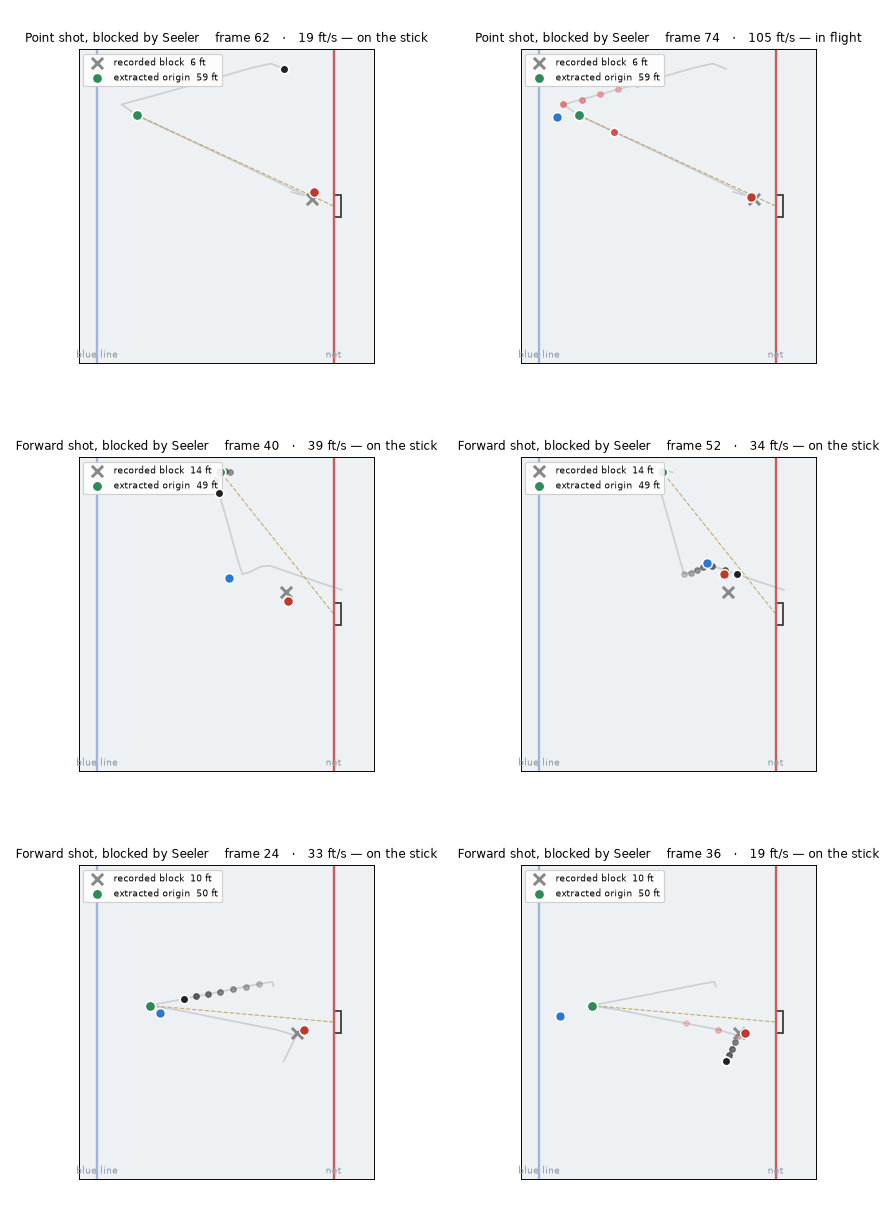
None of this is because public analytics is bad at defense. It is because the block, specifically, falls through every crack at once. Corsi counts a blocked shot as an attempt against — Seeler eats a puck and his on-ice numbers get worse. Fenwick and most public expected-goal models remove blocked attempts from the data entirely, so the act vanishes. The box-score blocks column counts volume, which can't distinguish a wall from a player who is merely besieged. And the play-by-play records every block where the puck died rather than where the shot came from, so even a model that wanted to price the act couldn't, off the public feed.
Fixing that took this site three posts: blocked shots belong in xG; their true origins can be recovered; and blocking is a repeatable skill worth actual goals. This post points the finished tools at one player.
What the stats could already see
Start with the part that is not new, because it carries half the case. The site's on-ice defensive number is a RAPM — regularized adjusted plus-minus, the approach Evolving-Hockey popularized in hockey — which measures the rate of expected goals a team concedes with a player on the ice, isolated from linemates, competition, and deployment. It is the number behind the defense rows on every player page, and it will get a full write-up of its own soon.
Two reasonable objections come up whenever the blocking number is shown, and the RAPM answers both.
The first: doesn't blocking already show up in shots against? It doesn't, and we checked. Blocking skill has essentially no relationship with how many attempts a player faces — part 3's follow-up measured this directly. So the two numbers keep separate books: the RAPM prices what arrives while a player is on the ice, and the blocking number prices what happens to an attempt after it is released. Adding them counts nothing twice.
The second: doesn't the blocking stat undervalue a player like Seeler? On its own, probably — it is deliberately conservative, sharing credit for every block across the defenders on the ice and shrinking each player's estimate toward zero. But blocking is one of three defensive channels the site prices. Whatever a defender does to keep chances from arriving at all lands in his RAPM, and the penalty kill is priced separately. The full defensive picture is the sum of the three, and the sum is where this post is going.
The league's best blocker — it isn't close, and it isn't luck
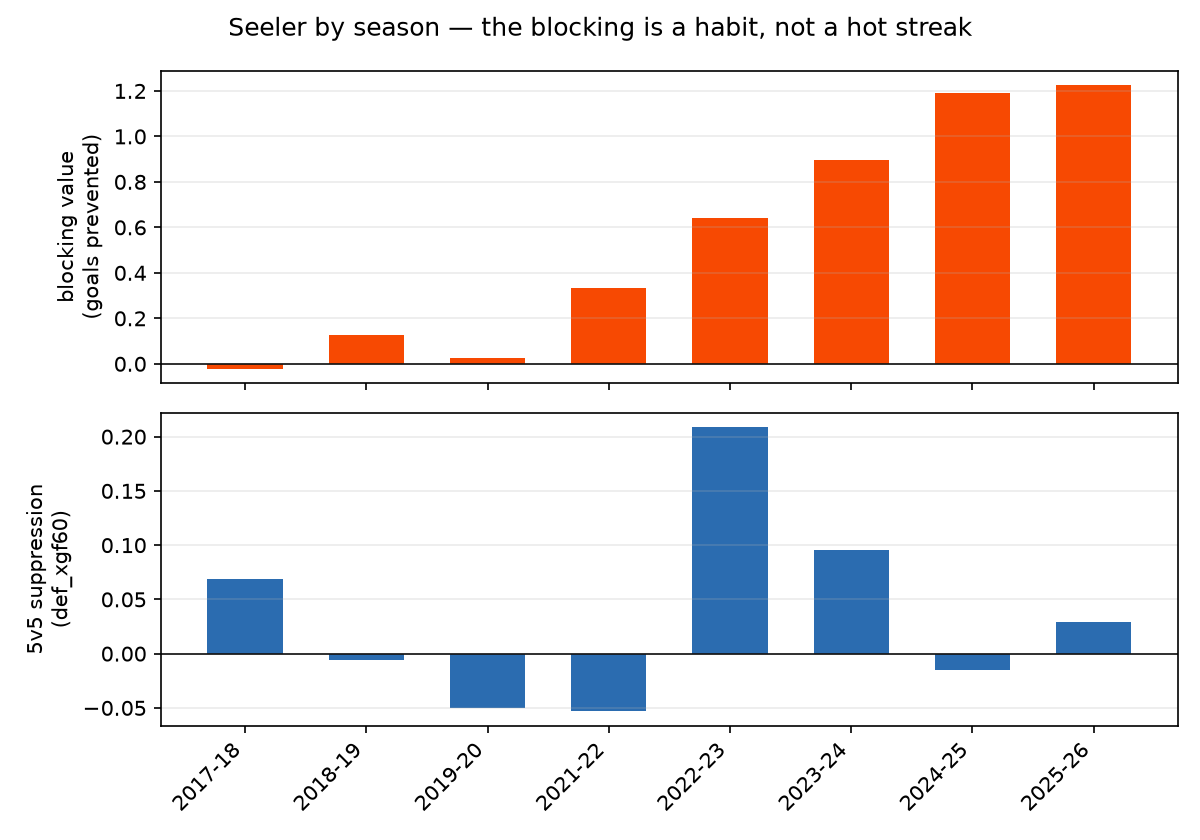
Pool the last three seasons and rank all 232 defensemen who played 1,000+ 5v5 minutes by blocking value per minute. Seeler is first. He and Ian Cole are a runaway pair — roughly double the rest of the league on total blocking value, with Seeler ahead per minute — and Seeler's seasons read +0.89, +1.19, +1.23 goals prevented: the league lead per minute in each, three years running. Part 3 told you the honest scale of this skill — about a goal a season is the most anyone earns by blocking. Seeler is the player earning it, every year, at the top of the league.
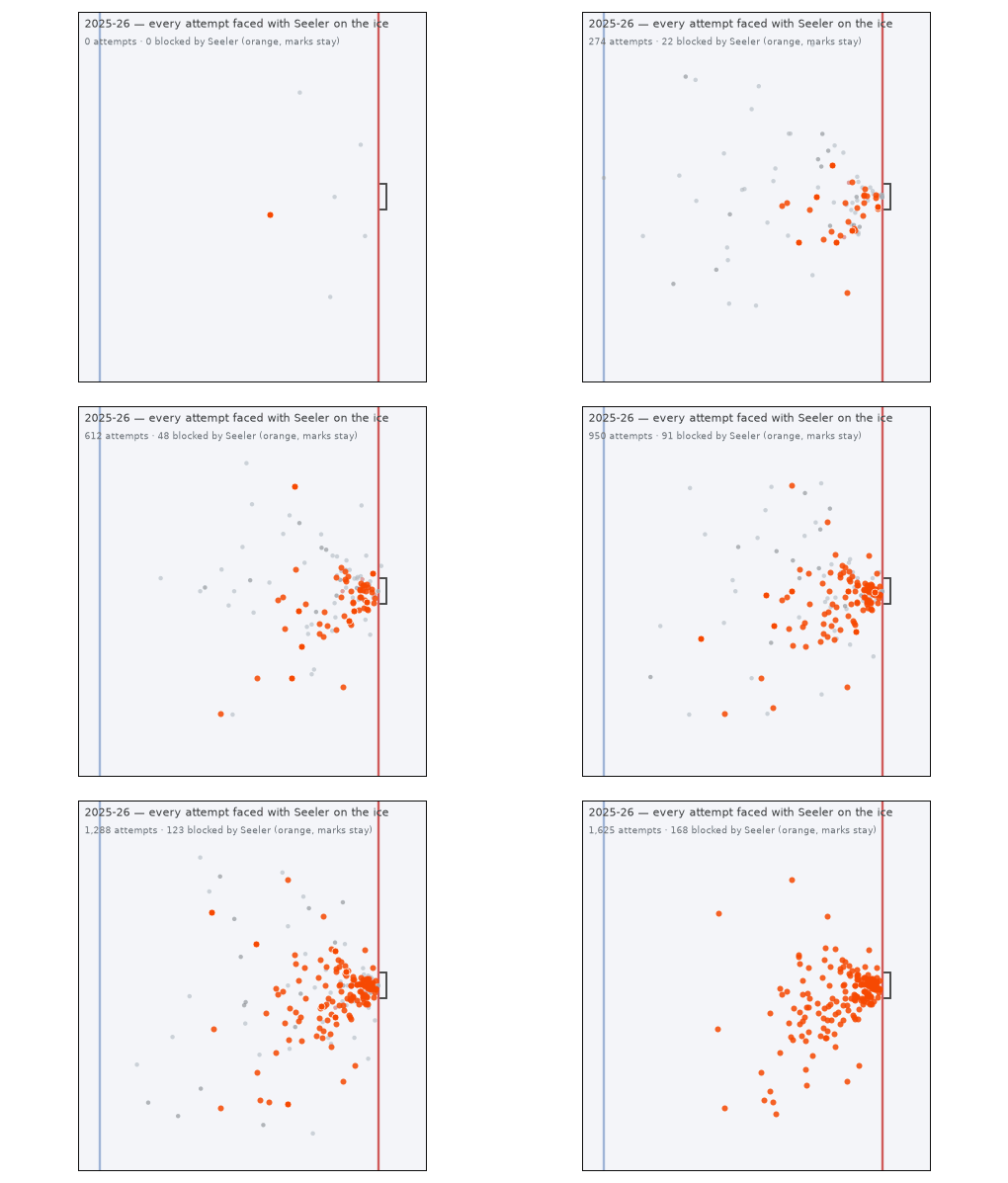
Two reminders about what that number is, because both matter here. First, it is measured against league average: +1.23 means Philadelphia conceded about a goal and a quarter less than they would have with an average defender facing the same attempts. The average defender blocks plenty of shots himself — the baseline is him, not an open lane, so this is the value of being the best at it, not the value of blocking at all. And second, it is influence, not an invoice: the model is never told who recorded a block. It watches every attempt he is on the ice for, block or no block, and works out how much more often attempts die with him out there. The scoresheet's block totals — the 168 orange marks above — are only used afterward, as an independent check the model passes. The number is a read on how he bends the ice, not a price tag on the pucks he personally ate.
Putting blocking value in context: the shooting comparison
A goal a season can sound like nothing, so here is the whole league on one plane for scale — every player's isolated shooting value against his blocking value, from part 3:
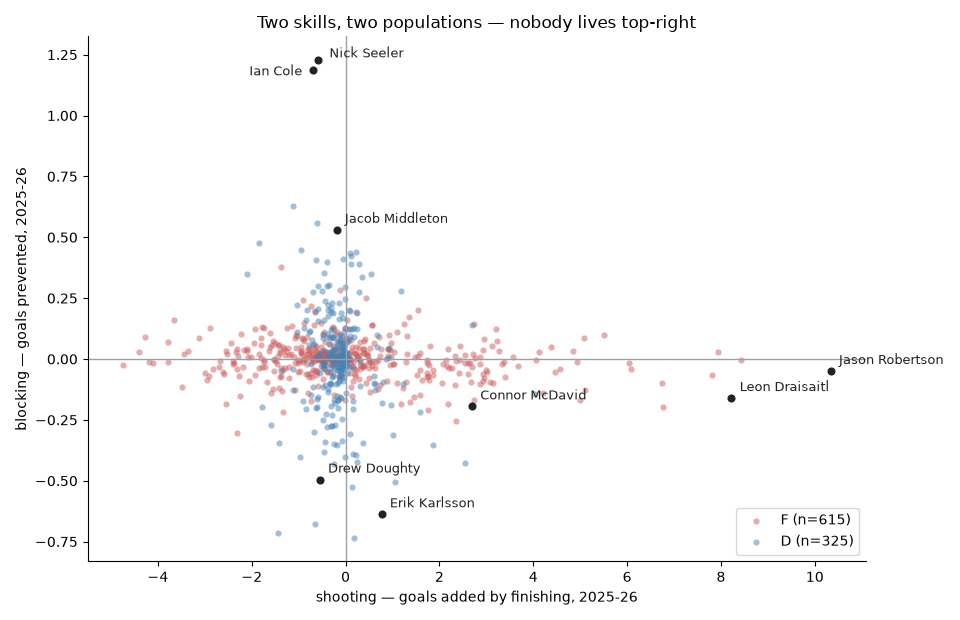
And an unfair-sounding comparison that the numbers happen to support: over the last three seasons Seeler prevented more goals with his blocking (+3.3) than Erik Karlsson added with his shooting (+2.1) — both measured against league average. That is a statement about how modest isolated shooting value is for defensemen, not a claim that Seeler is the more valuable player — Karlsson's on-ice offense (+15.4 over the same window) is where a star's value actually lives. But it puts the blocking channel on the map: at its peak, it is the size of a good offensive skill, not a rounding error.
Add it up: real, and rare
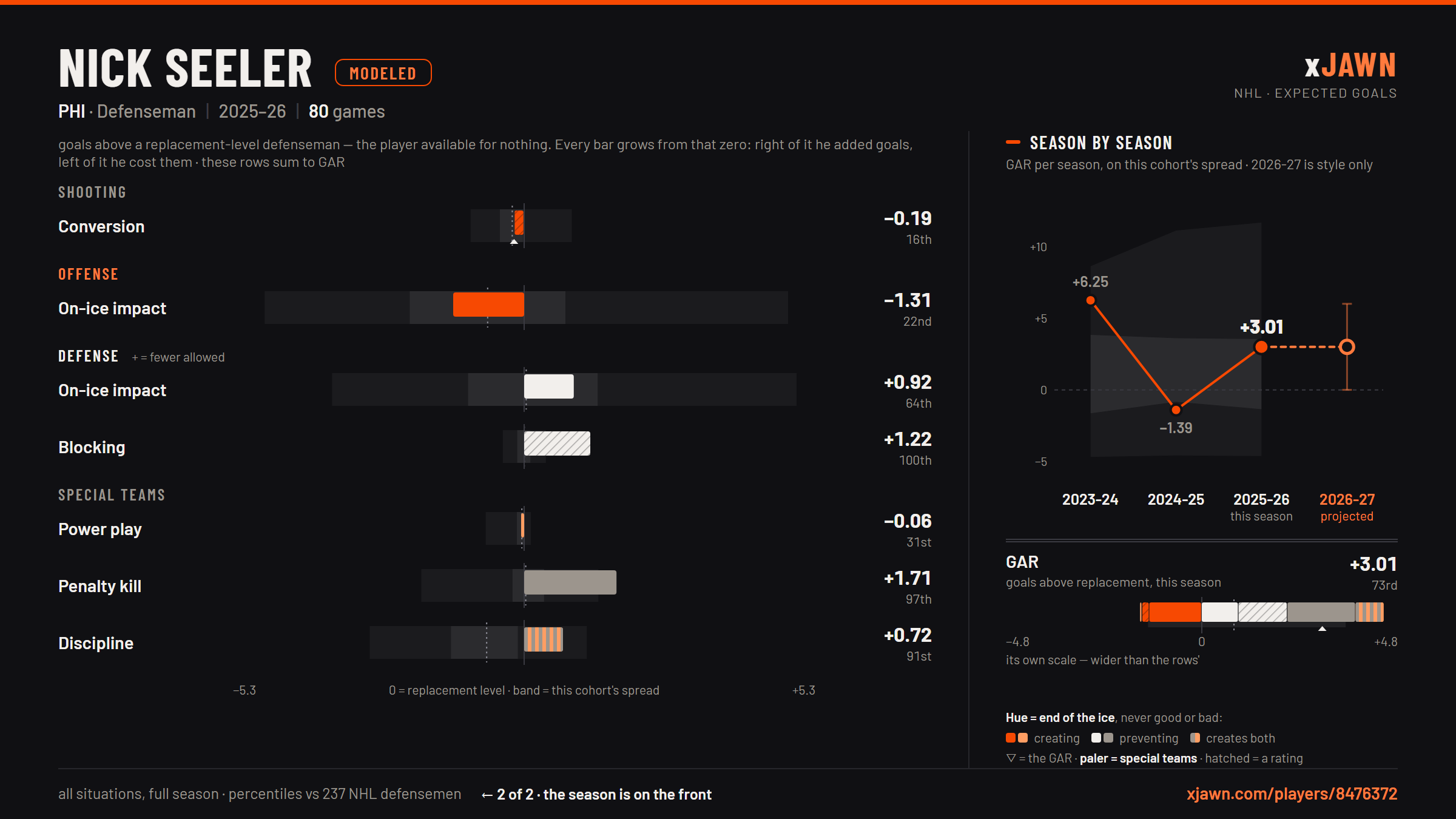
The site prices three defensive channels in goals: the RAPM's 5v5 chance suppression, the blocking, and the penalty kill — where Seeler, no surprise for the profile, is also excellent (+3.3 goals over the window, in a dead heat with his blocking as his largest channel). Sum them:
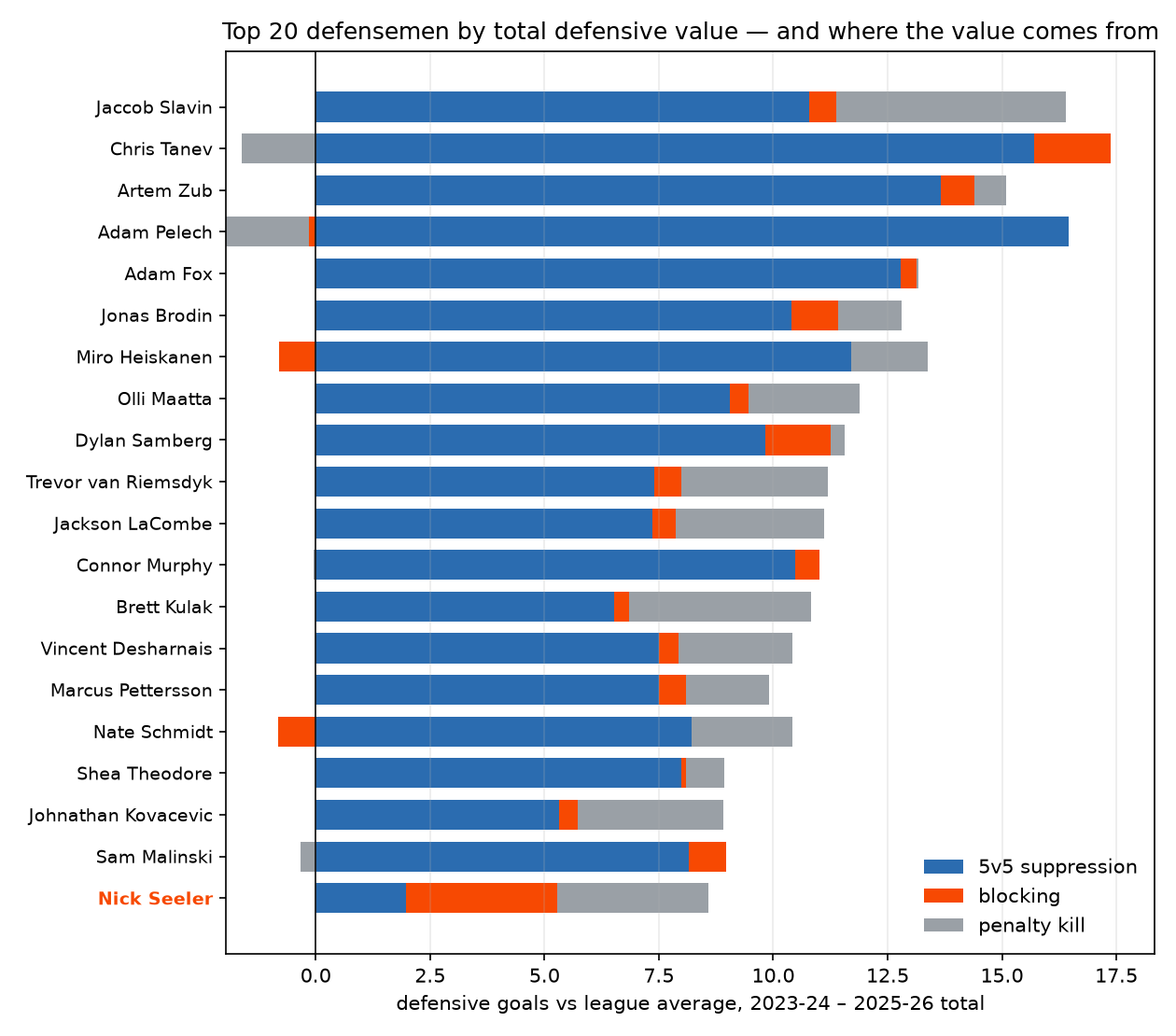
That figure is both halves of the title's claim. The archetype is real: a defenseman can crack the top decile of the league on defensive value delivered almost entirely through the specialist's doors — Seeler is 20th of 232 doing exactly that. And it is rare: he is the only player in that top 20 whose value arrives mostly through blocking and the kill. Chris Tanev shows up in every public model because his value lives in the channel they all audit. Seeler kept not showing up in most of them, for the same reason in reverse. The difference between them was never the quality of the defense; it was which door the value came through.
What he isn't, so you can trust what he is
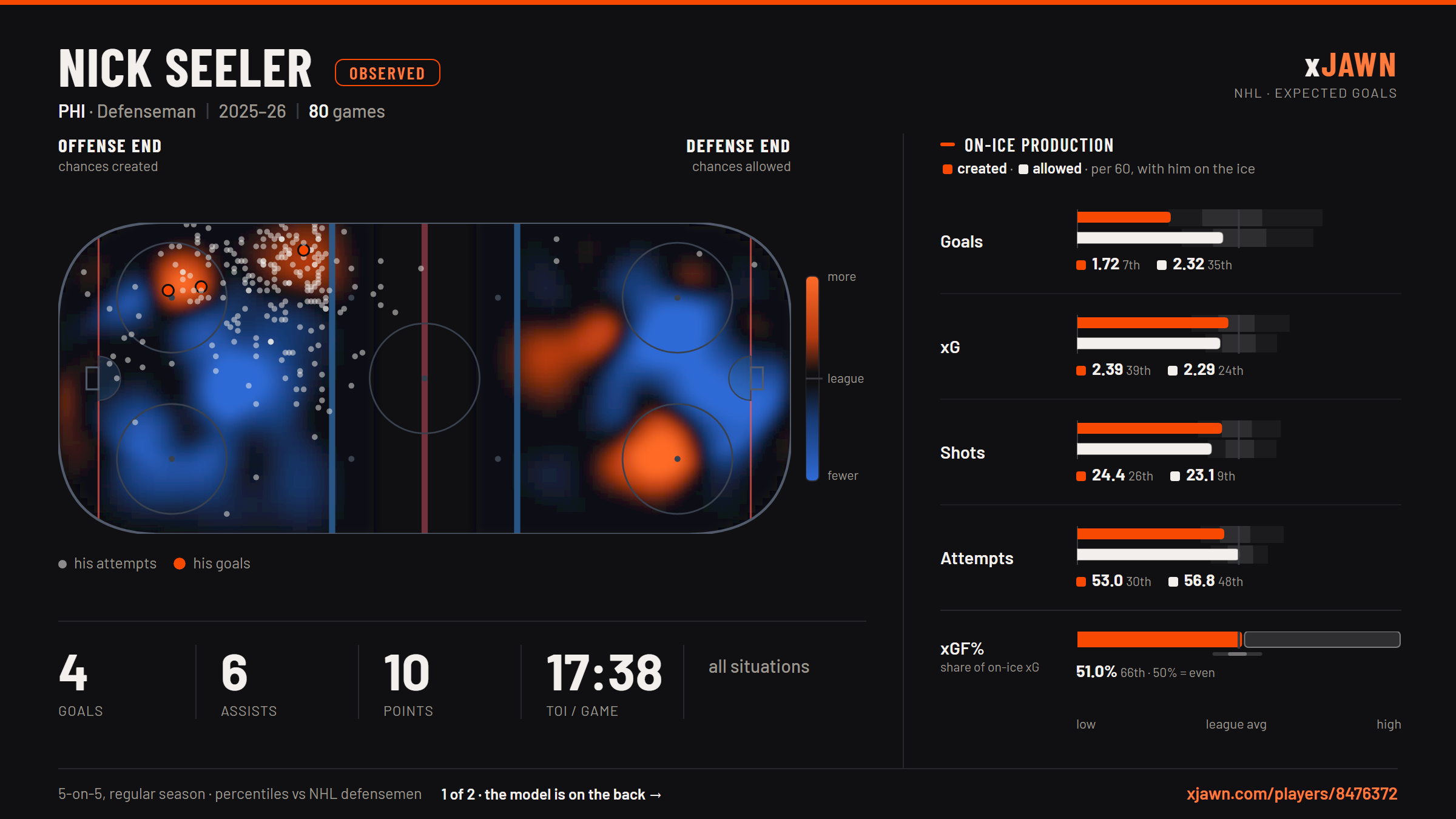
The same accounting that makes this case also says, and we report it because the whole series has been about not cherry-picking: his 5v5 offense is below average in nearly every season he has played — it is why his headline all-in value number is modest, and why he is a third-pair defenseman rather than a star. He takes more penalties than he draws, about half a goal a season's worth. The all-in number swings with that offense: 2024-25, inside this post's own window, was a genuinely bad year on the total, dragged by his coldest offensive season even as the blocking held at the top of the league. And the archetype may carry a bill this site has not priced yet — whether heavy shot-blocking costs its owners games to injury is a real question we are actively looking at, and an honest answer is hard because blocks and injuries are both entangled with ice time.
Here is the whole profile at once — both sides of his card, exactly as his player page draws them:
The test the archetype had to pass
Now the thought you were asked to hold. If the skeptics are right — if heavy blocking is what drowning looks like — then the plane below has a prediction to make: the top of the blocking axis should live on the bad side of the results axis. The players who block the most should be the players conceding the most, because the blocks are just the visible part of the siege.
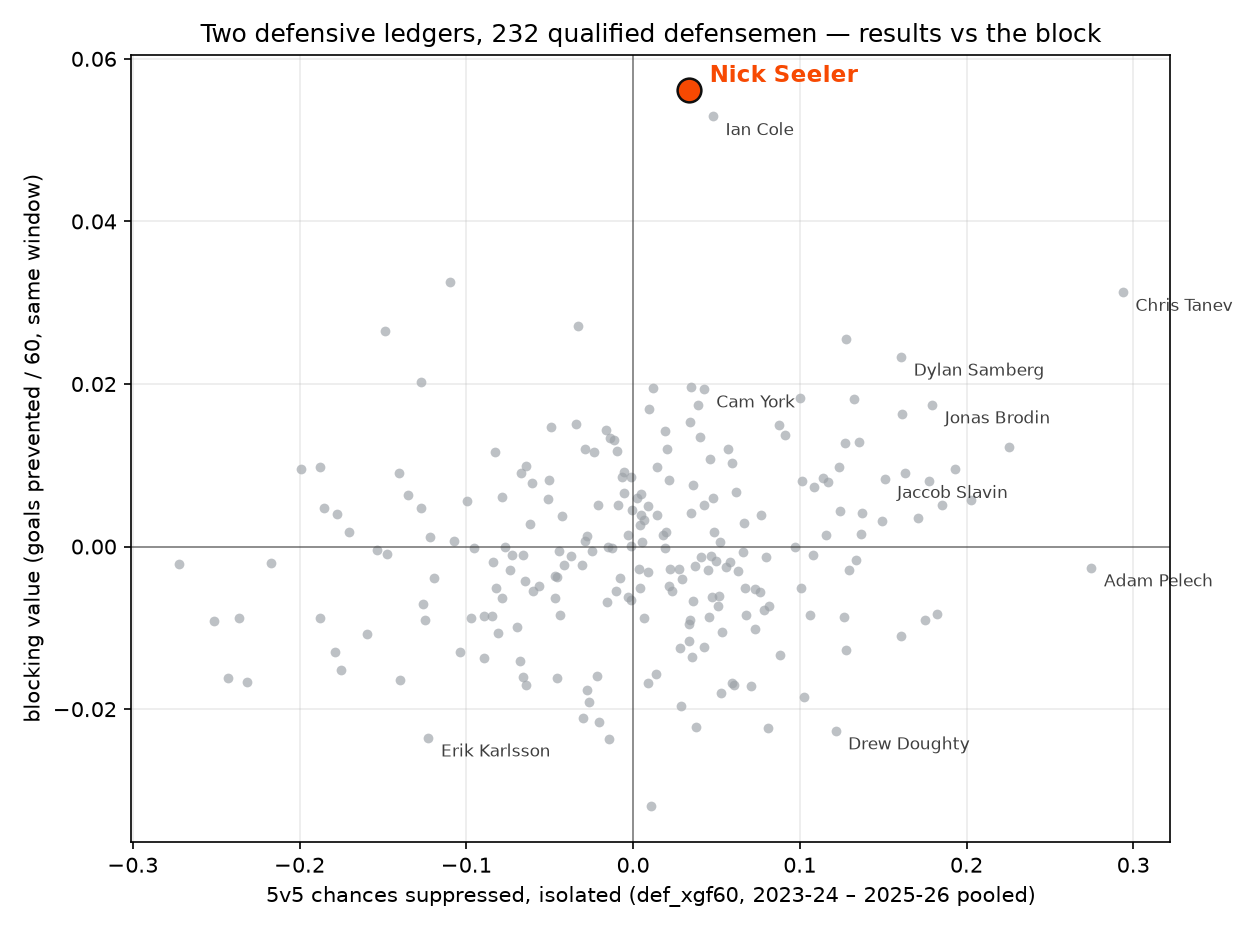
The prediction fails, and it fails at the exact point where it should have been strongest. Seeler — the single most extreme blocking specialist in the sport, the player the symptom theory was practically written about — is above average at even-strength suppression: 59th percentile, with every linemate, deployment, and competition excuse already isolated away by the RAPM. That is the honest number, and honesty matters more than hype here: 59th percentile is above average, not elite. Seeler is not Jaccob Slavin. But the archetype's critics didn't predict "not Slavin." They predicted drowning — and even league-average results would have beaten that prediction; he clears it with room to spare. Nobody here is calling him a superstar. The claim is narrower, and better supported: he is a genuine asset. The league's most extreme blocking specialist is also a perfectly sound defender at even strength — precisely where the symptom theory said he must be underwater.
One more Flyers note, because the map hands it to us: Cam York sits in the same upper-right neighborhood — 95th percentile blocking value, results above average. The Flyers' blue line carries two of the league's most model-invisible defensive profiles, which is worth remembering the next time a public ranking of the unit comes around.
So when Seeler's next contract, or his next healthy scratch, or his next trade-deadline mention gets argued about, the argument now has all three defensive channels priced instead of one. The blocks are real, they are skill, they are worth goals, and the player making them is not hiding a leak. Good defensive defensemen exist — the top of the defensive-value list is proof — and the list of players delivering that value the way Seeler delivers it has exactly one name on it.
Deeper reading
- Blocked shots, part 3 — the blocking stat this post spends, and what it's worth
- The player tables — Seeler's full accounting, alongside everyone else's