Blocked shots, part 1: the case for the shot that never arrived
A quarter of all shot attempts never reach the net, and most xG models throw them away. Why they belong — the shooter's-eye argument — and the data problem that keeps everyone else from using them.
Watch enough hockey and you stop seeing them. Roughly 28% of all shot attempts never reach the net because a defender got a shin pad, a skate, a glove in the way. The play-by-play calls it a blocked shot, the broadcast moves on — and most public expected-goals models quietly move on too: they are fit on unblocked attempts only, and a blocked shot contributes nothing to anybody's xG.
Our model scores every attempt, blocked ones included, and lately that choice has stopped being a detail. The newest version of our model is increasingly built around blocked shots — so this series is the case for that, in three parts. This post argues why blocked shots belong in xG at all, and names the data problem that keeps most models from using them. Part 2 shows how we recover the piece of data the league does not record. Part 3 takes what that opens up into the model itself.
The shooter's-eye argument
Expected goals is a claim about the moment of release: given where and how this attempt was taken, what is the chance it becomes a goal? Stated that way, the case for blocked shots nearly makes itself. At the moment the puck leaves the stick, whether it will be blocked is unknown — to the shooter, to the goalie, to the defender lunging into the lane. Up until that instant, a shot that is about to be blocked and a shot that is about to arrive are the same event: same spot, same look, same danger. The block is something that happens to the attempt afterward.
A block, in other words, is an outcome, not a precondition. It is one of the ways an attempt dies — alongside missing the net, hitting a post, being saved — and like the save, it is partly the product of defensive work. Score only unblocked attempts and you have conditioned your universe on something the defense did after release. Two things quietly go wrong:
- Real pressure vanishes by defensive decree. Whether an attempt counts toward a team's ledger becomes a decision made by the opposing shot-blockers. A team that generates forty attempts against a shot-eating defense did not generate less danger than the same forty against a passive one — but a blocked-shots-excluded model says it did, and credits the difference to nobody.
- The survivors are a biased sample. Blocks are anything but random: a long shot has a long path through traffic, and on forwards' shots we measure the block rate rising roughly 25-fold from the closest origins to the farthest (part 2 has the figure). Filter out the blocked attempts and the unblocked remainder is a systematically distorted picture of what the offense actually created.
And the block itself is information. Somebody chose to stand in the lane and got a piece — a deliberate, repeatable defensive act, and the only one the league writes down against individual attempts. Part 3 is about what happens when a model finally gets to treat it that way.
The precedent — credit where it is due
None of this is our insight. Micah Blake McCurdy of HockeyViz has been building xG models that score every attempt for years, and his Magnus family goes further: it decomposes a shot's fate into layers — is it blocked, is it on target, does it go in — and measures who influences each layer. That layered picture is the direct motivation for the nested structure of our own models. Our original v1 canonical model was a cascade of exactly that shape — P(through) × P(on net | through) × P(goal | on net) — and the new joint model in part 3 puts the cascade back at the center of the whole system. Our designs are inspired by Magnus rather than ported from it — the representations, the data, and the fitting machinery are ours, and where we borrow a mechanism we say so — but the thesis that a blocked shot is a real event carrying real information was his, argued early and convincingly.
So if they are useful, why doesn't everyone use them?
Because of a data problem the league has never fixed: the NHL does not record where a blocked shot came from. The play-by-play logs a blocked shot at the position of the blocker — where the attempt died, not where it was born. For the other 72% of attempts the recorded location is the shooter's; for blocks it is a different thing entirely, wearing the same column name.
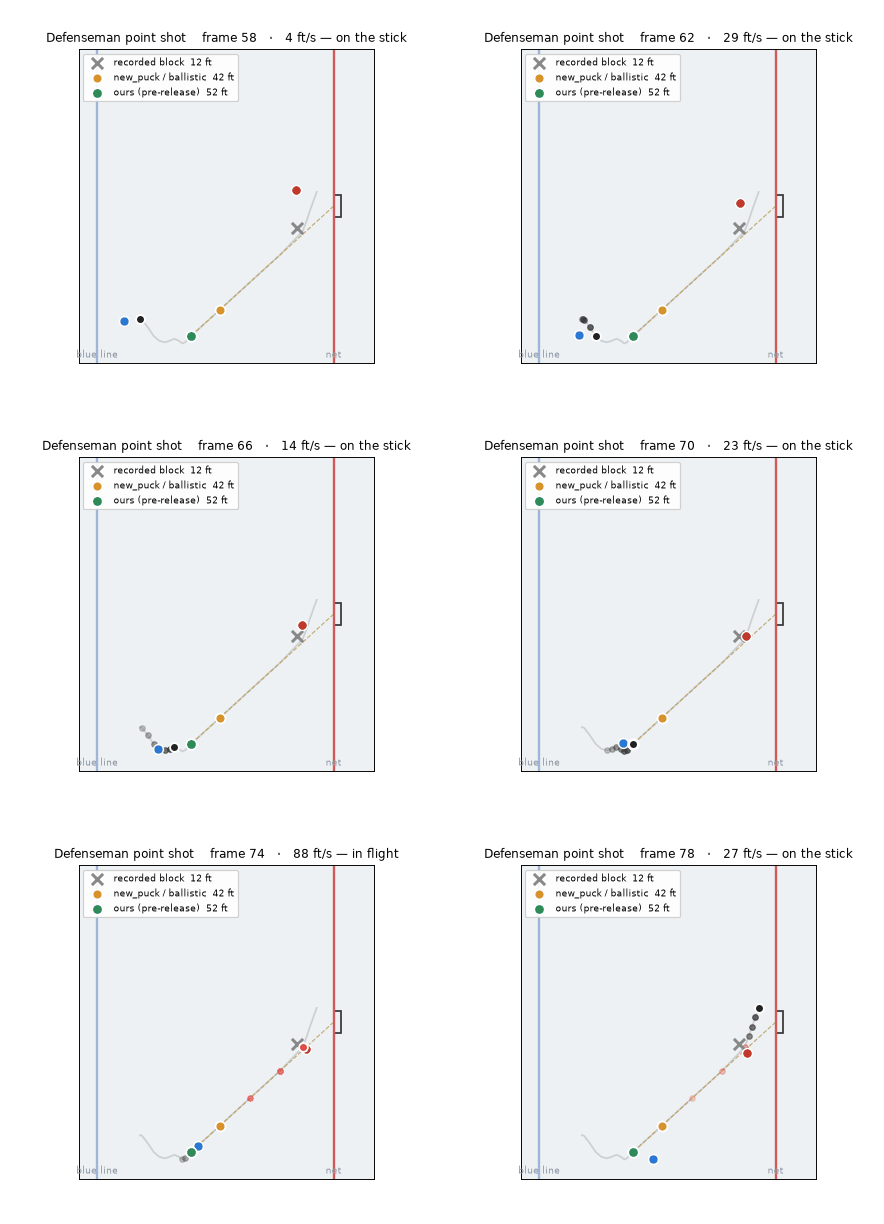
The gap is large, systematic, and lands almost entirely on one position. A defenseman's blocked shot is typically recorded around 28 feet from the net; the true origins sit around 52 feet — the point shot swallowed in the slot is the canonical case. Feed the recorded coordinates to a model and every blocked point shot is priced like a slot chance. The model learns, in effect, that defensemen constantly shoot from twelve feet and almost never score from there — and that distortion flows downstream into shot maps, team profiles, and any player rating built on top.
So a modeler is stuck between two bad options: drop blocked shots and lose 28% of all attempts along with the selection bias that filtering creates, or keep them at their recorded locations and poison the same 28% with coordinates that measure the wrong thing. The only way out is to answer the question the league didn't: where did this attempt actually come from? That is an imputation problem, it turns out to be a tractable one, and it is part 2.
Deeper reading
- Magnus 8: xG — McCurdy's layered model, the motivation for our nested design
- The talent-blind baseline — where these shots end up being scored