Blocked shots, part 3: blocking is a skill, and it has a number
The series finale. The model asks "does it get through?" as its own question, finds a skill that repeats like goaltending — and converts it to goals: about one a season for the league's best, owned by exactly the players the shot-attempt ledger punishes.
Part 1 argued that the quarter of all shot attempts that die on a defender belong in xG. Part 2 recovered where those shots actually came from. This post is the payoff: the players doing the blocking finally get measured — and get a stat.
Updated 8 August 2026 — does being good at blocking stop shots being attempted? The question readers asked most after this went up. Short answer: no, and the obvious way of checking gives you the opposite of the truth. Jump to the update.
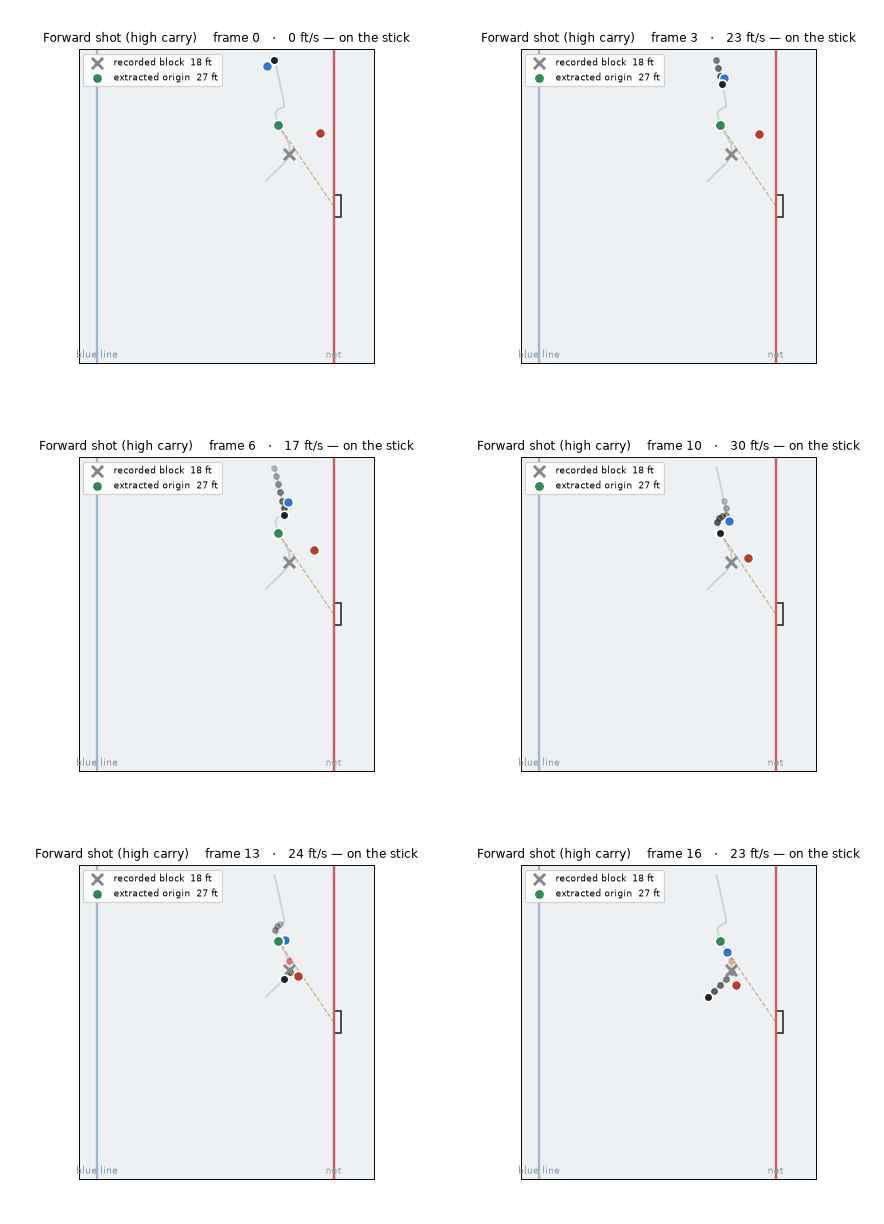
A model that follows the shot
Our shot model asks the three questions every attempt answers, in the order the shot answers them:
| Question | Who gets rated | |
|---|---|---|
| 1 | Does it get through? | the shooter — and the defenders on the ice |
| 2 | Is it on net? | the shooter |
| 3 | Does it go in? | the shooter and the goalie |
Multiply the three answers together and you get a shot's xG. The layered shape is not our idea: Micah Blake McCurdy's Magnus models made the case years ago for splitting a shot's fate into layers and asking who influences each one — part 1 credits that lineage properly — and our model borrows the mechanism while the data and the machinery are our own.
The part that matters for this post is the first question. Most shot models treat blocked attempts as noise to be filtered out; in ours, the first stage is entirely about them — and since a quarter of all attempts get blocked, that stage has an enormous amount of hockey to learn from.
Rating the blockers
Each question also carries ratings for the people involved. Shooters get rated on beating lanes, hitting the net, and finishing; goalies on saving. And on the first question, the defenders on the ice get rated on blocking: does this particular group, this particular player, turn more shots into blocks than an average group would?
One design choice is worth explaining because the whole stat rests on it. The model is never told who blocked the shot. The scoresheet only names a blocker when a block happened, so feeding that column to a model is handing it the answer — any "skill" it found that way would be fake. Instead, every defender on the ice shares responsibility on every attempt, block or no block, and the model works out over sixteen seasons of shots who consistently makes blocks happen more often.
Which frees the scoresheet's blocker column to do something better: check our work. The players the model rates as the best blockers turn out to be exactly the players who pile up recorded blocks — a fact the model never saw. And the rating repeats: a player's blocking number in half his games predicts the other half about as reliably as goaltending talent does, which for a defensive skill is remarkable. It behaves, in every way we can test, like a real ability.
The stat: blk60
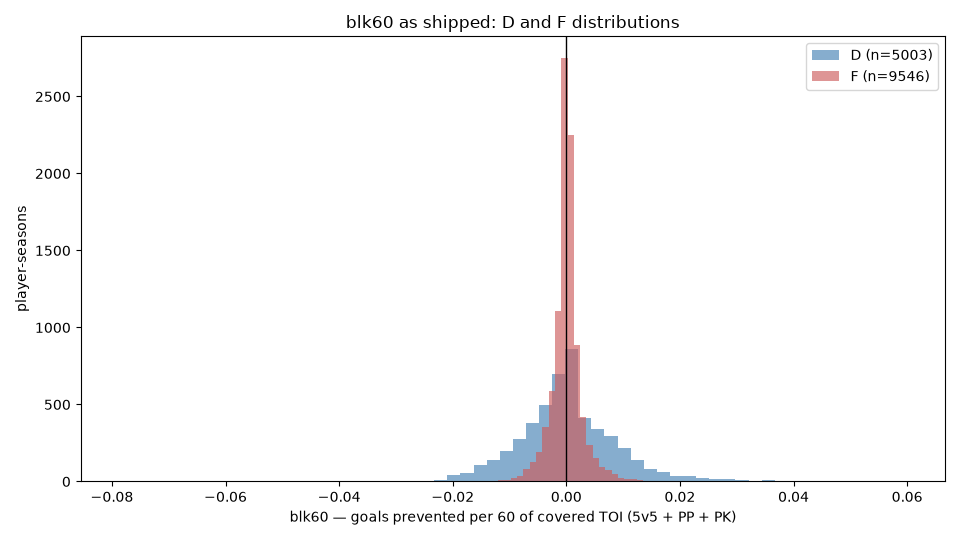
A rating is abstract. Goals are not, so we convert. Score every attempt — at 5v5, on the power play, and on the penalty kill — twice: once with the real defenders' blocking ratings, once with league-average defenders in their place. The difference is the goals a player's blocking prevented. Per 60 minutes of ice time, that's blk60. It's measured against each season's league in each of those situations, so across the NHL it sums to zero: goals prevented above average by some players are goals allowed below average by others.
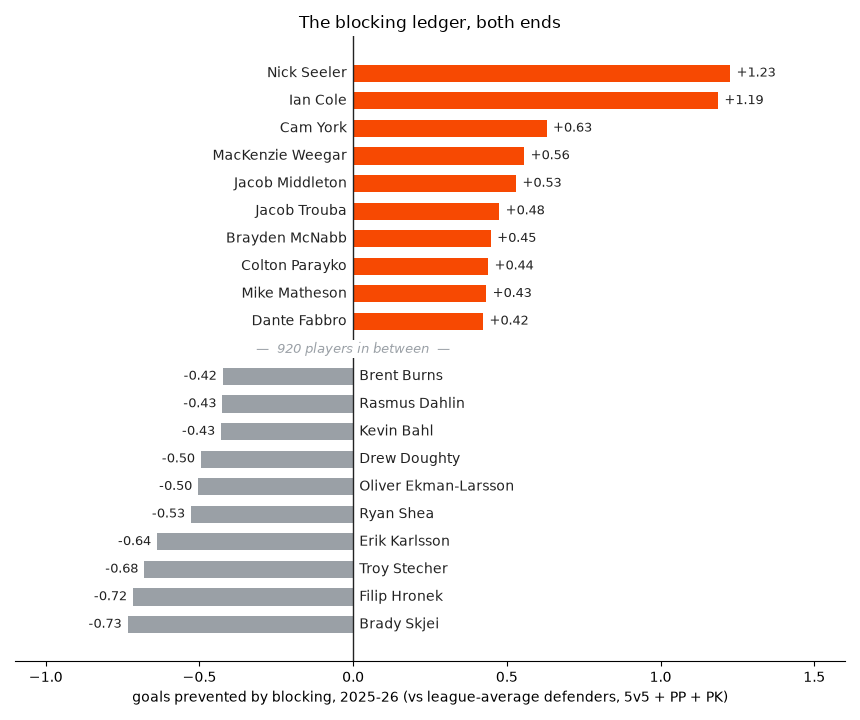
Here is the honest size of it, and it is smaller than the highlight reel suggests: the best shot-blocker in the league prevents a bit more than a goal a season beyond what an average defender would have, and the most block-averse players cost their teams half to three-quarters of a goal. For scale, an elite finisher adds five to eight goals a season with his shooting. Blocking is real, it repeats, and it is small — all three of those are true at once.
And it repeats where a reader can see it: year over year, half or more of the ledger's top ten comes back the next season, and the current No. 1 has held the spot three seasons running. For a stat this small, that stickiness is the tell that it is measuring a skill and not noise.
Who the numbers like
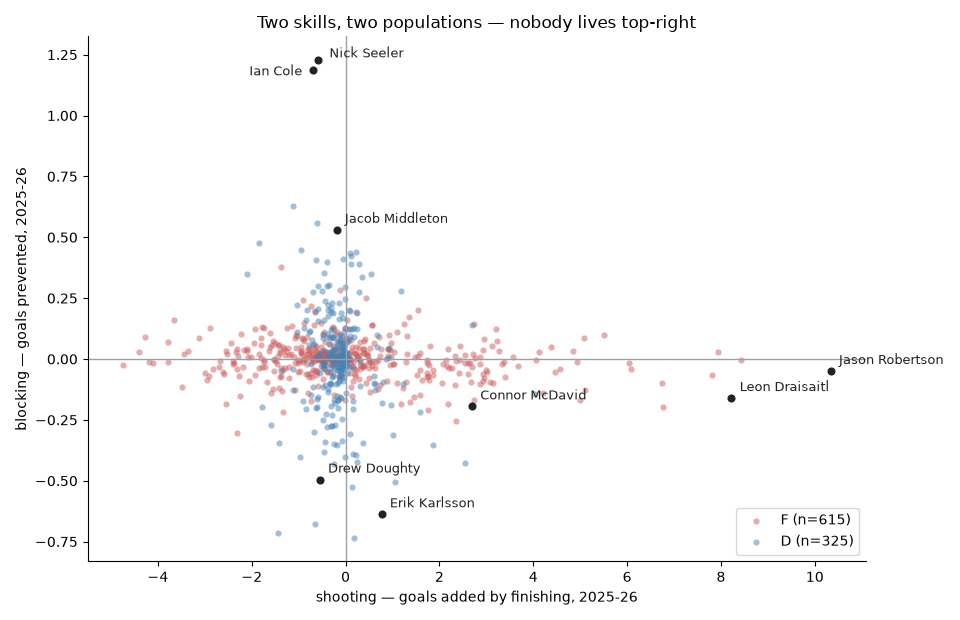
The current season's ledger puts six defensemen at the top, led by a near-tie the model has no idea is funny: Nick Seeler (+1.23 goals prevented) and Ian Cole (+1.19) — two players whose reputation among fans is precisely this, separated by a few hundredths of a goal. The rest of the top twenty reads like a scouting report on lane-eating: Middleton, Trouba, McNabb, Parayko, Brodin. The bottom is just as legible — famous puck-moving, offense-first defensemen: Karlsson, Doughty, Dahlin, Rielly, Ekman-Larsson. The extremes are all defensemen, but the forward ledger agrees — McDavid, who does everything with the puck and nothing in a shooting lane, sits in the bottom five percent. Nothing in the model knows a reputation, a Norris ballot, or a hit count; the names are it agreeing with your eyes from nothing but shot outcomes.
And notice that the two ends of the list are different kinds of player. Blocking and scoring turn out to be mildly opposed skills — the players who score don't block, and the players who block don't score. A ledger that only counts scoring isn't slightly underrating the blockers; it is not measuring them at all.
The fine print
- Most minutes, not all. The number covers 5v5, the power play, and the penalty kill — so penalty-kill blocking, arguably where the skill matters most, is counted. What isn't: 4-on-4, 3-on-3, and empty-net attempts, deliberately left out rather than quietly folded in.
- Influence, not volume. The rating measures what a player does to the attempts that happen in front of him, per attempt — it can't be farmed by playing for a team that gives up a lot of shots.
- A shared act. The defenders on the ice influence every attempt together, so a player's credit is his share of what the group did — exact bookkeeping, at the cost of a little blur between teammates.
So blocking is a skill, and now it has a number on the site's player pages. What it still needs is company: a block is one way to play defense, and the next post grades the other — what actually happens, chance by chance, while a defender is on the ice.
Update, 8 August 2026: does blocking stop the shot being taken?
This was the question readers asked most, and it is the right one to ask. Everything above measures what a blocker does to the attempts that happen in front of him. It says nothing about whether fewer attempts happen — so we went and measured that too.
The obvious way to check it gives you the opposite of the truth, and that is worth seeing before the answer. Put blocked shots per 60 against how well a team suppresses attempts with that player on the ice, and a strong relationship appears saying shot-blockers concede more. It is an artifact of the thing this whole series is about: you cannot block a shot nobody took. Blocks per 60 tracks attempts faced per 60 at +0.41, so most of what the counting stat measures is how much time your team spends hemmed into its own end. Run it that way and you would publish "shot-blockers give up more shots," with a real-looking number behind it.
Using blk60 instead — influence per attempt faced, the property that makes it unfarmable — the answer is a flat nothing. Across sixteen seasons the relationship between blocking skill and attempt suppression is −0.01 for defensemen and +0.03 for forwards, and not one season in either group gets anywhere near meaningful. That is not a we-couldn't-find-it null, either: blocking is one of the most repeatable things we measure (year to year, 0.91), and correcting away every bit of measurement noise in both numbers still caps any real relationship at 0.05.
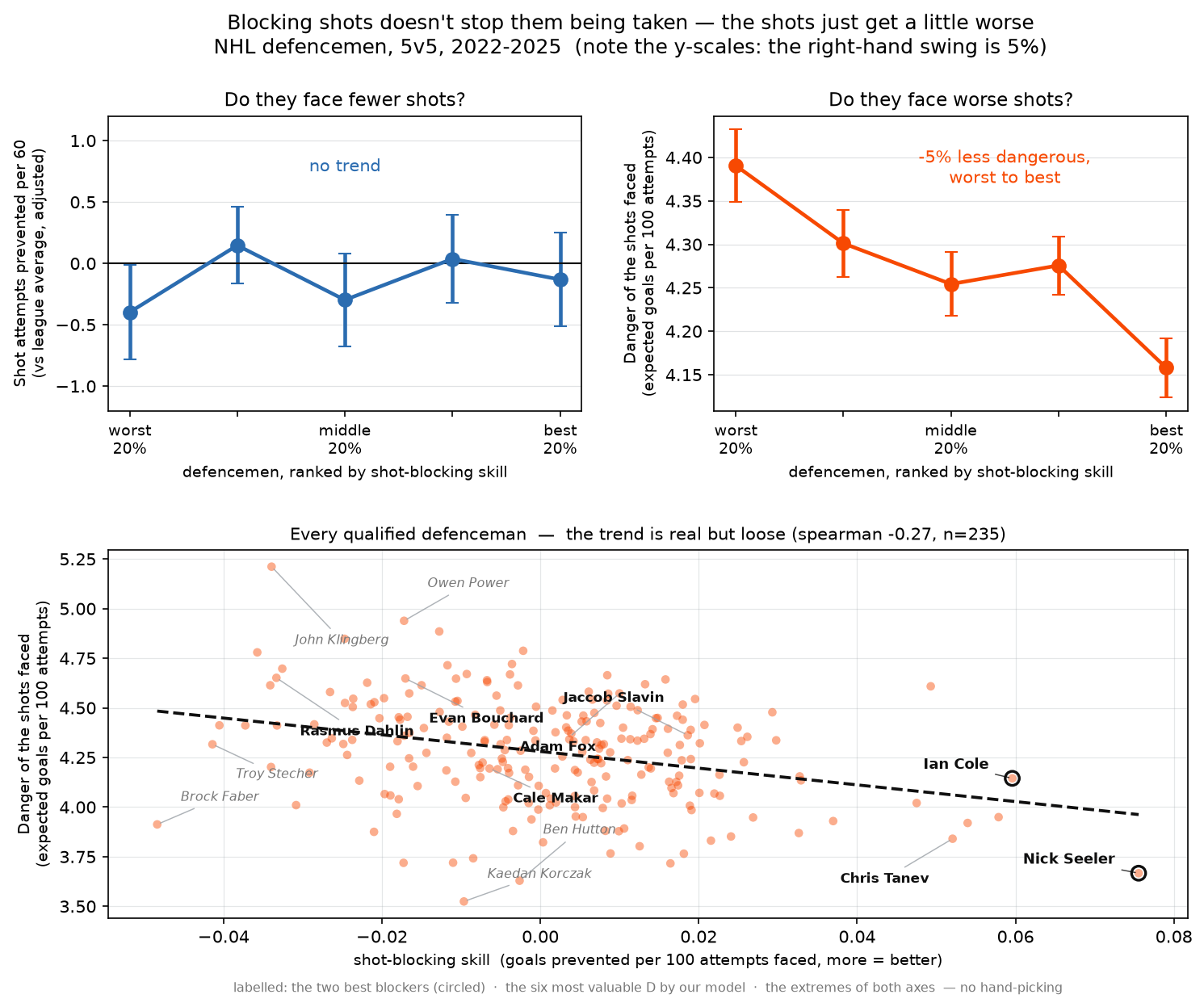
What does move is the quality of what arrives. Shots taken against the best blockers are about 5% less dangerous per attempt and come from roughly 0.7 feet farther out than against the worst. That holds up when you divide the blocking itself back out of the number — so it is not an accounting trick where blocked shots are cheap and blockers therefore look good. It is a real, small, repeatable difference in the shots that get thrown at these players.
One honest limit, and it matters. We can show good blockers face worse shots. We cannot show they cause it. Shots from the perimeter are both easier to block and less dangerous, so a defenseman deployed in a structure that concedes point shots will look like a strong blocker and face weak shots without deterring anybody. Separating those two needs a comparison we haven't run yet, and until we have, "faces" is the honest verb.
None of which walks back the stat. Blocking is still a skill, it still repeats, and it is still worth about a goal a season to the league's best. It just isn't deterrence — it doesn't stop the shot from being taken, it changes what happens to it.
Deeper reading
- Part 2 — the recovered shot origins this all stands on
- The player tables — where blk60 lives on the site