Believe the homecoming? What a 37-year-old legend has left
Patrick Kane is going home to Chicago at 37 on a two-year, $16M bet. Our aging curves say finishing only declines — and Kane's profile is the rare one where that's the good news.
On July 23 the Blackhawks made it official: Patrick Kane is coming home, on a two-year, $16 million deal — $8M a season, first reported by Elliotte Friedman. Kane turns 38 in November; the contract runs through age 39.
The romance writes itself, so it's worth remembering how it ended. Our model scores Kane's last Chicago season, 2022-23, at -0.34 goals per 60 below league average — 6th percentile, the floor of his career — played on a hip that was surgically resurfaced that June, for a franchise tearing itself down to the studs. Three one-year bets in Detroit later, he returns off an 87th-percentile season at 37. The warm version of this story tells itself. The colder question is the one the model can actually answer: what does a 37-year-old have left — and is it the kind of value that survives two more years?
What the model sees
His career on our 5v5 value curve — GAA/60, goals above league average per 60, split into the three things it sums: chances his line creates (Off), chances it suppresses (Def), and finishing. The same interactive chart that lives on his career page; click the legend to stack the components.
Switch to Single season and stack Off / Def / Fin to read 2025-26 directly. The chart opens mid-story: Kane debuted in 2007-08, three seasons before our data begins.
The arc: a genuine superstar peak (+0.30 to +0.40, 92nd–99th percentile, 2011-14), a long decade of good-not-great, the 2022-23 collapse, and the Detroit recovery — 77th, 43rd, 87th. This season: +0.24/60, split Off +0.10 · Def -0.04 · Fin +0.18. Roughly three-quarters of what's left is finishing — and his finishing term has sat between +0.14 and +0.19/60 for six straight seasons while everything around it wobbled.
That mix matters, because the three components are not equally believable. Across every skater since 2010-11, our stability study finds they repeat very differently year over year: defense is the least repeatable axis we measure (year-over-year r ≈ 0.32) — the line in the box score a single season most often fools you about — while finishing enters the value sum already regularized, with within-player swings roughly a tenth the size of either on-ice piece. Kane's value is concentrated in the most repeatable number we track.
What the aging curve says
Repeatable is not the same as immune to time, so we asked our aging study — every forward season since 2010-11, within-player year-over-year changes, so survivorship never masquerades as youth. The two curves disagree about what aging even looks like. On-ice offense is the classic arc: it peaks at 25.4 and falls faster after 28 — about −0.02/60 per year at Kane's age. Finishing never rises at all: forwards enter the league at their per-shot peak and give back about 0.001 goals a shot per year, every year, with no plateau — the gentlest and most predictable decline we measure.
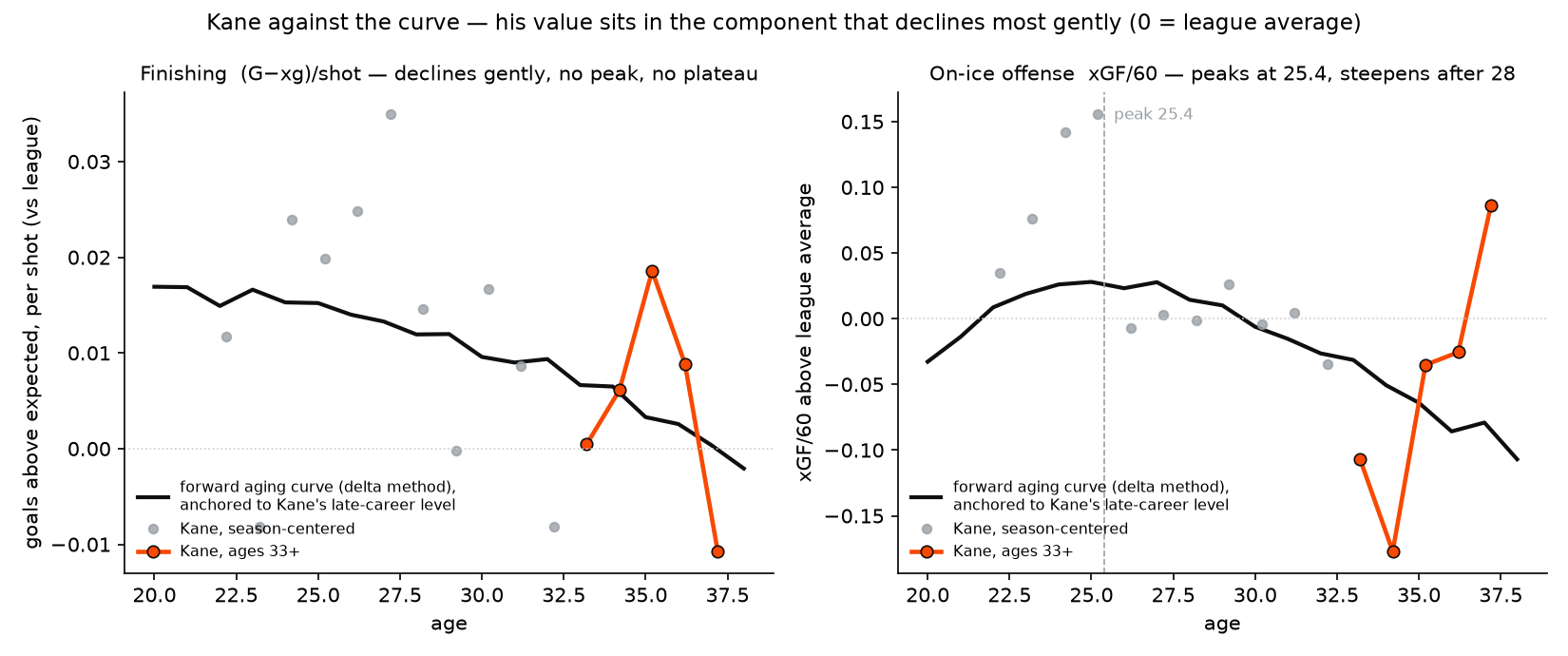
That's the quiet twist of this signing: Kane's remaining value sits in the component that declines the most predictably and the most gently. On his shot volume the finishing curve costs him roughly a goal and a half across the whole deal. And when we tested feeding these curves into the model's own player priors, the one-year aging adjustment helped in 11 of 14 seasons but by a hair (+0.0005) — at this horizon the curve tells you direction, not size. For a two-year deal, direction is most of what you need.
So, worth it?
$8M a year is not the incentive-laden flyer Detroit kept signing; it's a real bet. So apply the discipline first: our stability study says a single season should be shrunk by its measured slope (0.55), which pulls +0.24 back to about +0.13/60. And the pooled 3-season view agrees: +0.11/60 (76th percentile). This is not a bet on believing one season — every estimator we have says Kane is still an above-average 5v5 contributor, and the curve's gentle slope keeps him there through the deal on paper. What $8M is really buying beyond that — the power play, the sweater sales, a credible bridge to the young core's window — our model doesn't score, and a healthy Kane next to Connor Bedard is worth something no isolation metric will ever see.
So the honest verdict: the hockey bet is defensible on the numbers. The risk isn't that 2025-26 was fake — it's actuarial. Year two of this contract lands at age 39, past the right edge of everything we can measure.
The caveats, plainly
The old-age tail is our aging study's weakest ground. Players who decline hardest leave the league before contributing their worst seasons, so our curves are a lower bound on late decline — and even that lower bound runs out of data at 38. Age 39 is extrapolation, full stop. Finishing's stability is partly by construction: the finishing term pools career evidence, and that same artifact absorbs the league's rising finishing environment — a caveat that matters here precisely because Kane's value is finishing-concentrated (his raw one-season finishing in 2025-26 actually came in a hair under expected, well inside noise at ~300 shots). And his defensive number (−0.04) rides the axis our stability study trusts least (r ≈ 0.32) — that caps the downside story, nothing more. Bets on 37-year-olds don't usually get this much benefit of the doubt from a model. This one earns it — everywhere except the birth certificate.