Believe the breakout? What a single season is actually worth
The Flyers just made Jamie Drysdale their highest-paid defenseman on a four-year, $26M bet. Our model on whether it's a good one — a real defensive step, and the one-season noise that keeps it a bet.
On July 18 the Flyers signed defenseman Jamie Drysdale to a four-year, $26 million extension — a $6.5M cap hit that makes the 24-year-old their highest-paid defenseman, ahead of Travis Sanheim. It's a real commitment to a former sixth-overall pick who has spent five seasons as more promise than production. Is he worth it?
Our read: it's a bet — but a reasonable one, and one our model can see the shape of. Drysdale is coming off comfortably the best season of his career, the numbers agree with the eye test on why, and the upside the Flyers are paying for is a plausible extension of it. Here's the case, and the honest caveat that keeps it a bet rather than a sure thing.
What the model sees
This is his career on our 5v5 value curve — GAA/60, goals above league average per 60, split into the three things it sums: chances his line creates (Off), chances it suppresses (Def), and finishing. It's the same interactive chart that lives on every career page; click the legend to stack the components, and toggle the smoothing at the top.
Switch to Single season and stack Off / Def to read 2025-26 directly.
Two things stand out in 2025-26. His offense sits right around league average (-0.02/60) — no longer a drag, not yet a driver. But his defense — the chances his team gives up with him on the ice — jumped to +0.10/60, and that's enough to make his overall game a positive contributor for the first time in his career (+0.10/60, 69th percentile among defensemen). The eye test says the same thing — he looks steadier in his own end — and it's genuinely intriguing that the model lands exactly where the eye does: the step forward was defensive.
The caveat: one season, and a method that knows it
Here's why it stays a bet. That +0.10 is a single-season estimate, and our RAPM approach — which isolates a player from his teammates — is sensitive to how much ice time it has to work with. One season is roughly 1,500 5v5 minutes, and that's noisy. Toggle the chart to 3-season weighted and Drysdale drops back below average: the smoothing still remembers two rough earlier years. So how much should you trust one good season?
We can answer that empirically — every skater from 2010-11 to 2025-26, 7,987 season pairs. Ask how well a season predicts the next one:
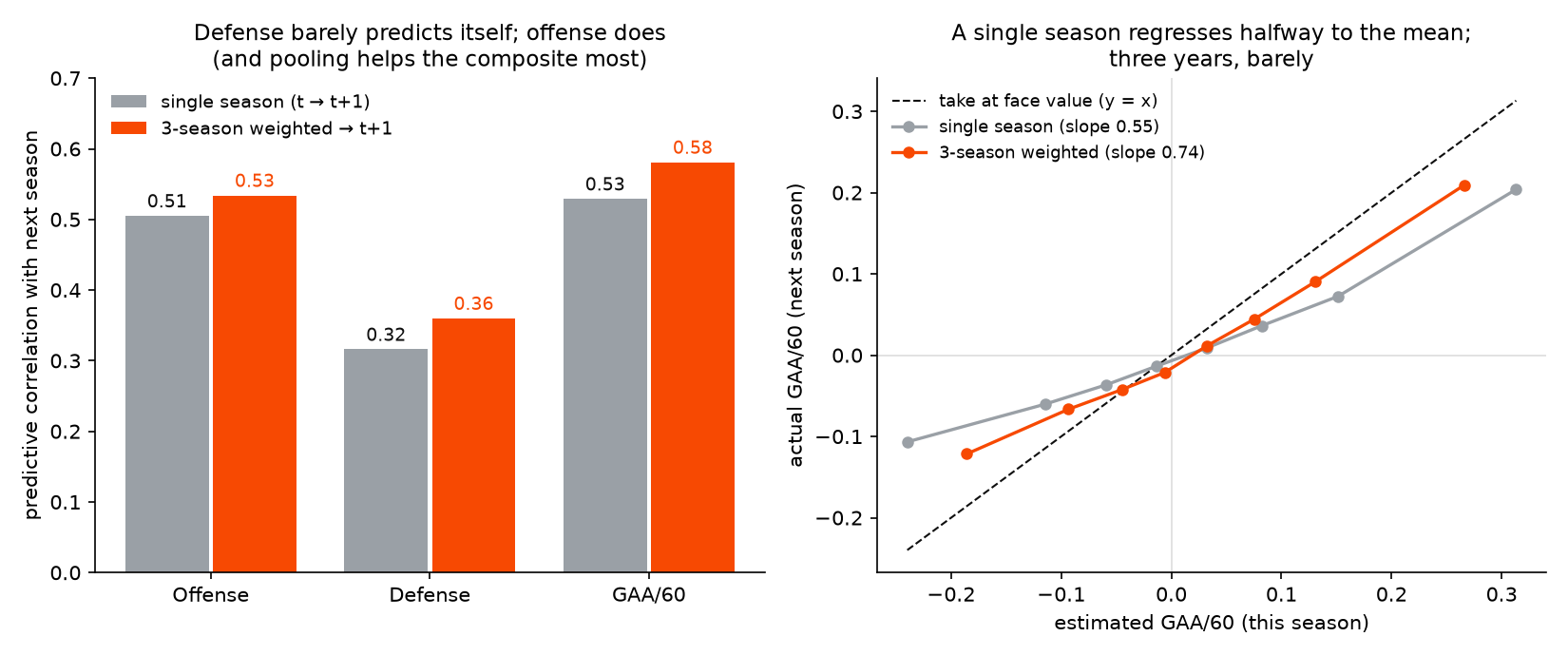
A single season of GAA/60 predicts the next at r ≈ 0.53; three years pooled, 0.58. And the two halves of his game behave nothing alike: offense repeats (r ≈ 0.51), while defense barely predicts itself year to year (r ≈ 0.32). Chance-suppression is exactly where one season fools you — so the very thing that improved for Drysdale is the piece our data says to trust least over a single year.
So, worth it?
The numbers are noisy at this stage of his development — he's 24, with the shortest track record of any recent big Flyers deal. But noise cuts both ways, and what our model does capture is the intuition that his defensive improvement is legitimate: the eye test and an isolation metric that never saw the eye test agree on it independently. That's what makes $6.5M a reasonable bet rather than a reach.
And it points at the tell to watch. His offense is the half that sticks — the repeatable one — and right now it's merely average. If Drysdale can add a little offensive pop to a defensive game that's finally arrived, this contract won't just look reasonable. It'll look like a bargain.